Strengthening Voices: English Coffee Storytelling for Baristas and Farmers in Papua

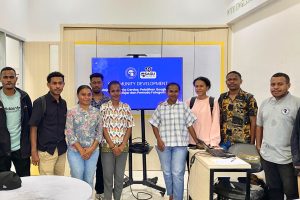
The growing popularity of coffee in Indonesia has created new opportunities for the coffee industry, where storytelling plays a vital role in introducing brands and sharing the unique journey behind each cup (Mahendra et al., 2024). For Papua coffee, storytelling highlights the dedication of smallholder farmers and strengthens connections with customers. In response, English Coffee Storytelling was developed as a training program to improve the English communication skills of baristas, farmers, and coffee enthusiasts, focusing on vocabulary building and storytelling techniques related to Papua coffee. Held on 18–19 March 2025 at the SAGU Foundation and Highland Roastery, the two-day training involved 8 participants and offered interactive sessions for practicing how to share their coffee experiences in English.
In the face of globalization, local coffee industry actors especially baristas and coffee farmers in Papua face challenges in cross-cultural and language communication. In response to this challenge, the English Coffee Storytelling initiative emerged as a community development project that combines a deep passion for coffee with a strong commitment to improve the English proficiency of coffee communities in Papua. As a tutor at the SAGU Foundation and an active practitioner in the coffee industry, I view supporting baristas, local farmers and coffee enthusiasts as a meaningful way to apply my expertise while contributing to capacity building within the community. This aspiration reflects my commitment to knowledge sharing and the development of human resources in the coffee sector.
The results of the post-training evaluation indicated that 86% of participants found the training materials to be relevant to their professional needs. Furthermore, the practical sessions were well-received, with an average class performance score of 82. Participants also provided constructive feedback, including a recommendation to extend the duration of the training to allow for more in-depth practical sessions. This would improve their comprehension and application of coffee related English. One participant, Herlina Werbabkay, stated that the tutor’s teaching approach was highly engaging, which significantly facilitated participants’ understanding of the material.
During the training, several challenges were encountered. One of the main issues was the language barrier, which was addressed by using simplified English and visual aids to support learning. Additionally, some participants lacked confidence, so the trainers facilitated small-group activities that helped create a more supportive and comfortable learning environment.
One of the important lessons learned is that storytelling can bridge learning with the real life experiences of the participants. Connecting the material to local contexts proved effective in increasing learning motivation and strengthening participants’ sense of identity as part of the Papua coffee community.

In conclusion, English Coffee Storytelling is more than a language training, it is a platform for building confidence, strengthening community bonds, and amplifying the voices of Papua’s coffee storytellers on a global stage. For me, this initiative is a reminder that language is not just about grammar, but about connection, identity, and pride. I hope similar activities can be implemented in other coffee producing communities across Papua.
References
Mahendra, M. C., & Rahmana, A. (2024). Storytelling Marketing Design of Wanaland Coffee Roastery To Improve Brand Awareness. Jurnal Aplikasi Bisnis dan Manajemen (JABM), 10(3), 834-834.
| Disclaimer: This content is based on the author’s personal experiences of English Coffee Storytelling initiative. AI tools were utilized to enhance clarity and grammatical accuracy, without altering the authenticity of the author’s original insights. |
Author :

English Tutor

You may also like
1-Day Training Workshop For GKI Sunday School Teachers